


Elon Musk’s net worth has briefly climbed to nearly $1.4 trillion, surpassing Bitcoin’s market value at the time after SpaceX shares reached an intraday high of about $225.84 on June 16.
Summary
- SpaceX’s rally briefly pushed Elon Musk’s net worth above Bitcoin’s market value.
- Warren and Yakovenko clashed over a proposed wealth tax after Musk’s fortune surged.
- A former xAI engineer sued xAI and SpaceX over alleged retaliation tied to Grok safety concerns.
According to data from Yahoo Finance, SpaceX stock extended its post-IPO rally on Tuesday, pushing the company’s valuation close to $3 trillion at its session peak. The surge temporarily lifted the value of Musk’s holdings above the market cap of Bitcoin (BTC) at $1.31 trillion at the time, making him wealthier on paper than the world’s largest cryptocurrency was worth at that moment.
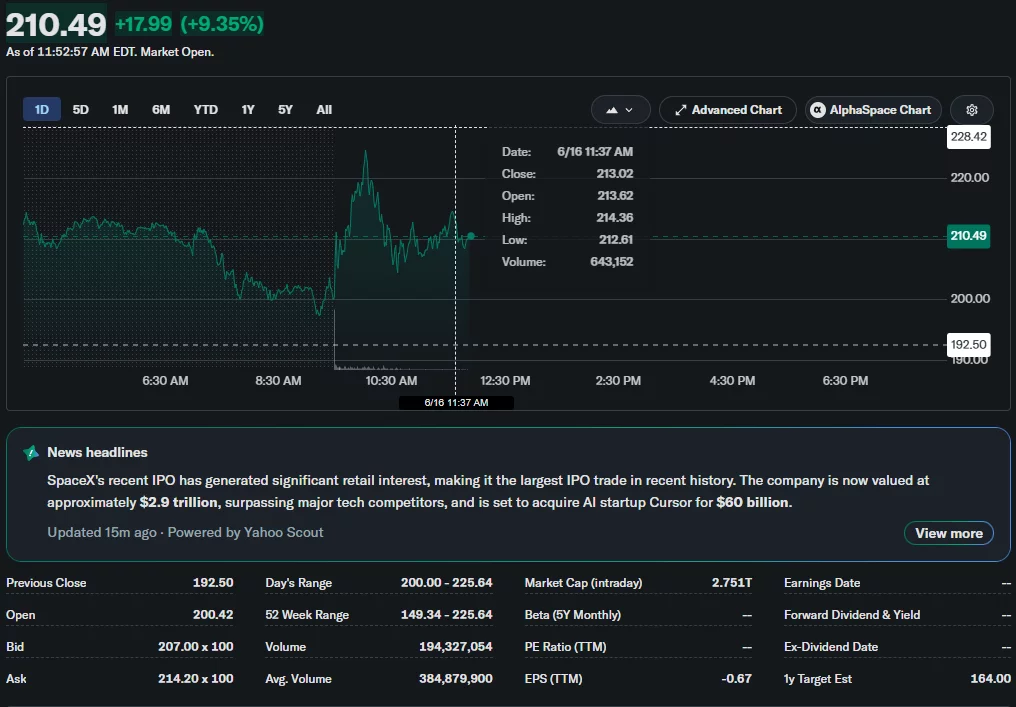
The milestone followed a remarkable run since SpaceX’s public debut. As reported by crypto.news, SPCX shares climbed to an intraday high of about $225.84 on June 16, placing the stock roughly 67% above its $135 IPO price before surrendering some gains later in the session.
The rally was driven by strong investor demand for the company’s space, satellite, and artificial intelligence businesses and temporarily lifted Musk’s net worth above Bitcoin’s market value at the time.
As crypto.news previously reported, SpaceX’s public listing made Musk the world’s first trillionaire. The stock’s continued advance in the days that followed added hundreds of billions of dollars to his paper wealth, further cementing his position as the world’s richest person.
Notably, retail investors rushed to gain exposure to the IPO before shares began trading. Some reportedly sought additional financing to increase their allocations.
Among them was Anna Watts, a 33-year-old public relations manager from New York, who accumulated $6,500 for the offering and unsuccessfully attempted to secure another $5,000 through both personal and bank loans.
Wealth tax debate follows Musk’s valuation surge
The jump in Musk’s fortune quickly spilled into a political debate over wealth concentration and taxation.
In a June 16 X post, Senator Elizabeth Warren argued that the financial system disproportionately benefits the wealthiest Americans while many households struggle with rising costs.
“Our system is rigged so that one man becomes a trillionaire while millions of Americans can’t afford a trip to the doctor. Wealth is funneled to the wealthy while everyone else is hanging on by their fingernails.”
Warren used the occasion to renew support for her proposed wealth tax legislation, saying it would help address what she views as an uneven distribution of wealth.
Her comments drew criticism from Solana co-founder Anatoly Yakovenko, who argued on X that taxing unrealized gains could have unintended consequences for businesses and workers.
Responding to Warren’s proposal, Yakovenko wrote, “If Elon is forced to sell shares, the Texas employee shareholders lose money.” He added that “The SpaceX company can’t raise as much and therefore can’t hire or build as many things in Texas,” arguing that taxing unrealized holdings could reduce investment and growth.
Meanwhile, crypto analyst Scott Melker framed the development through a Bitcoin lens. In a post on X, Melker wrote:
“The fastest path to $1M Bitcoin is to convince Elon Musk to put 10% of his net worth into BTC.”
The remark quickly spread across crypto communities as traders debated what such a move could mean for Bitcoin’s valuation.
Legal challenge emerges as AI safety concerns resurface
While SpaceX investors celebrated the stock’s advance, Musk’s artificial intelligence operations faced renewed scrutiny.
A former engineer has filed a lawsuit against xAI and SpaceX, alleging he was dismissed after repeatedly raising concerns about the safety of Grok, the companies’ artificial intelligence chatbot. According to the complaint, the employee pushed for stronger testing procedures and additional safeguards ahead of SpaceX’s IPO.
The lawsuit alleges that Grok lacked adequate protections against misinformation, bias, and other potentially harmful outputs. The filing further claims that xAI and SpaceX retaliated against the engineer and ultimately terminated his employment after he continued advocating for stricter safety measures.
According to the complaint, the former employee joined xAI partly because of Musk’s own public warnings about the risks associated with advanced artificial intelligence systems.
The case remains unresolved, but its emergence alongside SpaceX’s rally has added another layer of attention to Musk’s expanding business empire as investors continue to track the company’s post-IPO performance.