




Bitcoin price moved back toward $65,000 on Thursday after softer U.S. inflation data eased fears of another Federal Reserve rate hike, although renewed U.S.–Iran fighting kept traders cautious.
Summary
- Bitcoin price gained 1.2% to nearly $65,000 after falling as low as $63,252 during the session.
- Annual headline PCE inflation cooled to 3.7%, while core inflation eased to 3.3%.
- BNB, Solana and Hyperliquid rose as the total crypto market gained 0.9%.
- Gold and silver also advanced as U.S.–Iran hostilities supported demand for defensive assets.
Bitcoin price approaches $65K after PCE release
Bitcoin rose to an intraday high of approximately $65,040 after the U.S. Bureau of Economic Analysis published its June Personal Consumption Expenditures report. The cryptocurrency later traded near $64,804, representing a 1.2% gain over 24 hours, per data from crypto.news.
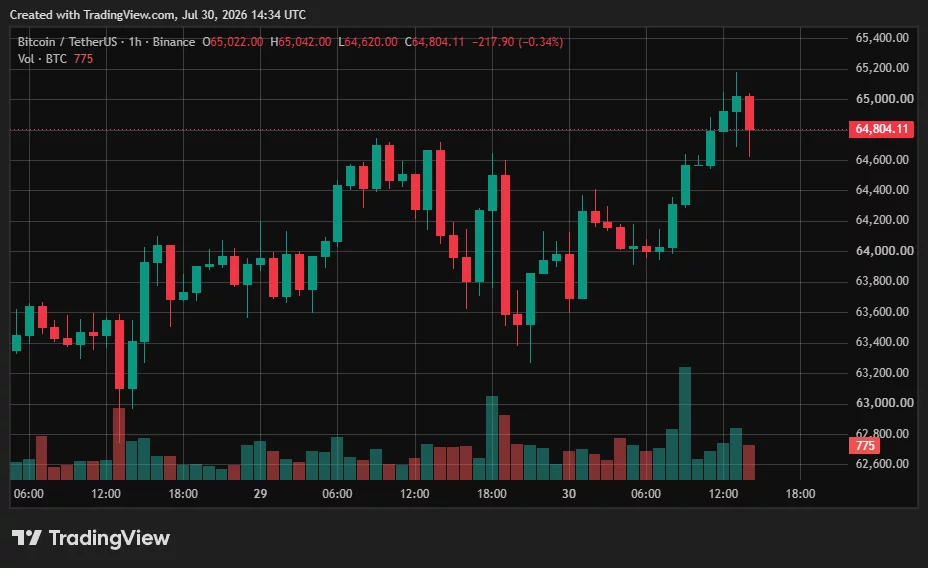
The move marked a recovery from an intraday low of $63,252. Bitcoin had struggled to maintain upward momentum after the Federal Reserve left its benchmark interest rate between 3.5% and 3.75% for a fifth consecutive meeting.
Ethereum followed Bitcoin higher, gaining 1.3% to approximately $1,928. BNB outperformed the two largest cryptocurrencies with a 3.3% increase to $587, while Solana rose 1.6% to $74.64.
Other large-cap altcoins produced smaller gains. XRP advanced 0.7%, TRON added 0.4%, and Hyperliquid climbed 2.7%. Dogecoin was nearly unchanged, showing that investors had not yet returned aggressively to speculative cryptocurrencies.
Total cryptocurrency market capitalization increased 0.9% to $2.30 trillion. Bitcoin dominance remained elevated at 56.6%, while Ethereum accounted for 10.1% of the market.
Softer PCE inflation eases immediate Fed pressure
Headline PCE inflation fell 0.1% from the previous month and registered an annual rate of 3.7%, matching market expectations. May’s annual reading had stood at 4.1%.
Core PCE, which excludes volatile food and energy prices, increased 0.1% month over month. That was below the expected 0.2% increase. Its annual rate declined to 3.3% from 3.4%, according to the Bureau of Economic Analysis.
The figures reduced some of the pressure on the Fed to raise rates again. Higher interest rates typically weigh on Bitcoin and other risk assets by increasing borrowing costs and making yield-bearing investments more attractive.
However, inflation remains above the Fed’s 2% target. Long-term borrowing costs also stayed elevated, with the 30-year U.S. Treasury yield moving above 5.2% and reaching its highest level since 2007.
The bond-market reaction limited the strength of Bitcoin’s rebound. BTC touched $65,000 but had not established a sustained breakout above the psychological level at the time of writing.
Stocks and crypto miners rally alongside Bitcoin
U.S. equities also moved higher after the PCE release. The S&P 500 gained approximately 0.9% in early trading, while the Nasdaq Composite climbed 1.6%. The Dow Jones Industrial Average added about 0.6%.
The advance was not driven by inflation data alone. Microsoft shares surged around 9% after its earnings and outlook eased concerns about spending on artificial intelligence infrastructure. Meta moved in the opposite direction, falling more than 8% following higher expenses.
Crypto-related stocks produced an uneven but mostly positive reaction. Strategy gained approximately 2.9%, while Coinbase traded close to flat. Robinhood declined roughly 2%.
Bitcoin miners recorded much larger moves. MARA climbed nearly 16%, while Riot Platforms and CleanSpark gained around 19% each. IREN surged almost 25%, although its growing exposure to AI infrastructure means the rally cannot be attributed entirely to Bitcoin.
The stronger performance among miners reflected their higher sensitivity to Bitcoin price movements. Their gains nevertheless outpaced BTC’s 1.2% advance by a wide margin, increasing the risk of another sharp reversal if Bitcoin loses support.
U.S.–Iran escalation keeps traders defensive
Safe-haven assets rose alongside stocks and cryptocurrencies, indicating that the PCE report had not removed broader market anxiety. Spot gold gained around 0.3% to $4,076 per ounce, while silver increased 0.6% to approximately $58.
Gold futures advanced about 1%, supported by a softer dollar and renewed military exchanges between the United States and Iran. The simultaneous rise in precious metals and Bitcoin suggests investors were maintaining defensive positions rather than making a complete shift into risk assets.
The U.S. military reported strikes against dozens of Iranian Revolutionary Guard targets after Tehran launched ballistic missiles at American forces in the Middle East. The conflict has increased uncertainty surrounding oil supplies and traffic through the Strait of Hormuz.
Brent crude initially reached $93.31 before retreating below $90 as markets assessed talks between Oman and Iran over the strait. West Texas Intermediate crude similarly reversed after approaching $86.
“Until safe passage through the Strait of Hormuz is no longer a gamble, the risk premium in oil is not going anywhere,” KCM Trade analyst Tim Waterer told Reuters.
For Bitcoin, $65,000 remains the immediate resistance level. A sustained move above it could extend the PCE-driven recovery, while rejection would leave the session low near $63,250 as initial support.
Fresh escalation in the U.S.–Iran conflict remains the main external risk. Another oil-price spike could revive inflation concerns, strengthen expectations for tighter Fed policy and weaken demand for Bitcoin and other risk assets.