




The CLARITY Act’s narrowing path through the U.S. Senate could trigger another crypto sell-off before the market recovers later this year, according to Bernstein analysts.
Summary
- CLARITY Act passage odds have fallen to 28% as the Senate’s summer recess approaches.
- Bernstein expects a failed vote or delay to produce an immediate negative crypto market reaction.
- The bill remains absent from the Senate’s Aug. 3 schedule, leaving lawmakers only days to act.
- An Aug. 5 cloture filing could allow an initial procedural vote on Aug. 7.
CLARITY Act misses the Aug. 3 Senate schedule
The Digital Asset Market Clarity Act, or CLARITY Act, was not included in the U.S. Senate’s published schedule for Monday, Aug. 3, reducing the time available for lawmakers to begin floor proceedings before the summer break.
The official Senate schedule lists a 5:30 p.m. cloture vote on the motion to proceed to H.R. 6500, a legislative vehicle for a continuing resolution. It does not include scheduled action on H.R. 3633, the CLARITY Act.
The Senate’s cloture ledger also records the July 30 filing for H.R. 6500 but no corresponding petition for the crypto market-structure bill.
The omission does not prevent Senate Majority Leader John Thune from bringing up the legislation later in the week. However, it leaves the bill without a publicly confirmed floor timetable before the Senate’s tentative state work period begins on Aug. 10. The break is scheduled to continue through Sept. 11.
Bernstein warns of another crypto market decline
Bernstein analysts said a Senate failure to advance the bill could generate an immediate negative response across Bitcoin and the broader crypto market.
The analysts described the possible reaction as an industry “knee-jerk” sell-off that could produce another leg down for digital asset valuations. The warning comes as Bitcoin trades under pressure, and investors monitor whether Congress can complete its crypto policy agenda before the midterm elections.
“From a tactical standpoint, we expect the crypto market to bottom and start showing momentum towards late Q3 and early Q4 prior to the mid-terms,” Bernstein analysts wrote in a Monday report shared with clients.
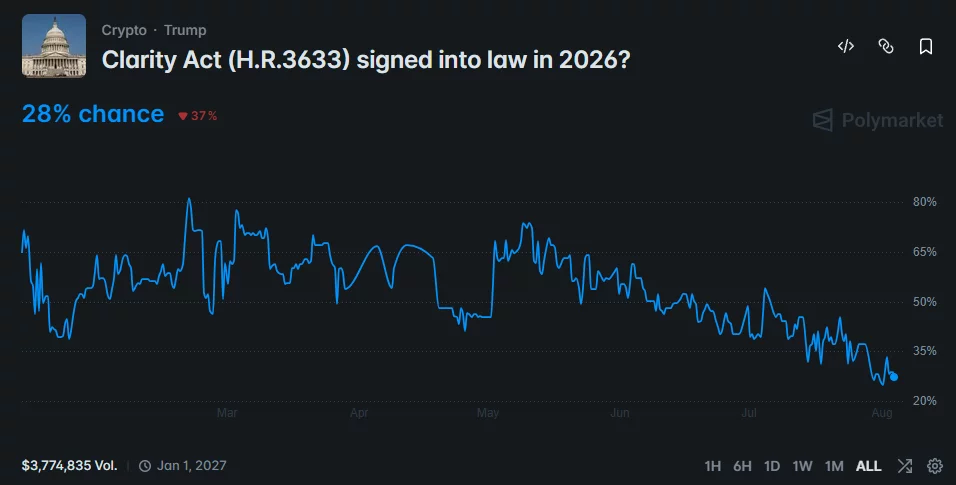
Prediction market traders have also become less confident. Polymarket places the probability of the CLARITY Act passing before the end of 2026 at 28%, down 10 percentage points over the past week and 12 points over the past month. Traders have wagered about $3.77 million on the market.
Galaxy Digital previously cut its estimated probability of the legislation becoming law this year to 50%, citing the Senate’s limited remaining calendar.
Regulators could move faster if Congress fails to act
Bernstein said a legislative delay could pressure the Securities and Exchange Commission and Commodity Futures Trading Commission to provide more regulatory guidance through Project Crypto.
The joint initiative seeks to use the agencies’ existing authority while Congress works on a permanent market-structure framework. Bernstein expects regulators could issue interpretations covering token classifications and decentralized finance while accelerating a proposed exemption for some token issuances.
Such an exemption could temporarily shield qualifying token offerings from securities requirements under defined conditions. Agency guidance, however, would not provide the same statutory certainty as legislation passed by Congress.
The CLARITY Act would establish rules for digital asset issuers and trading platforms while dividing oversight responsibilities between the SEC and CFTC. Senator Cynthia Lummis released updated legislative text on July 22, combining work from the Senate Banking and Agriculture committees.
Banking groups have opposed parts of the proposal, arguing that its stablecoin provisions could allow crypto platforms to offer rewards without facing requirements comparable to those imposed on banks.
Aug. 5 may be the final practical filing window
Under the Senate’s standard Rule XXII process, a cloture petition requires signatures from 16 senators. A petition filed Wednesday, Aug. 5, could allow a cloture vote on Friday, Aug. 7, if the chamber remains in session.
That vote would only determine whether the Senate limits debate on the motion to proceed. It would not pass the CLARITY Act. Invoking cloture on legislation generally requires 60 votes and can permit up to 30 additional hours of consideration.
Senators would still need to vote on the motion to proceed, debate amendments, and hold a final passage vote. A second cloture process could also be required.
White House officials are meanwhile considering a bipartisan ethics proposal negotiated by Republican Senator Thom Tillis and Democratic Senator Ruben Gallego. The proposal would reportedly allow state attorneys general to challenge the Justice Department when it fails to enforce federal ethics rules.
With no floor action yet scheduled, the Senate’s remaining days before recess will determine whether the CLARITY Act advances now or returns to an increasingly crowded agenda in September.