



Lite Strategy has invested $1 million in Litecoin Layer-2 developer ZK Innovations, extending its involvement beyond LTC accumulation and into infrastructure tied to the cryptocurrency’s future development.
Summary
- Lite Strategy invested $1 million in LitVM, a Layer-2 project bringing smart contracts to Litecoin.
- The deal gives Lite Strategy governance rights and potential exposure to future LitVM tokens.
- Santiment data showed Litecoin whale wallets rising despite weak transaction activity and recent price declines.
According to Lite Strategy, the funding gives the Nasdaq-listed company governance participation rights in the project and the opportunity to acquire a portion of LitVM’s future network tokens.
The investment centers on LitVM, a zero-knowledge Layer-2 platform designed to bring smart contracts, decentralized finance applications, tokenized real-world assets, and cross-chain liquidity tools to Litecoin.
The move comes as Lite Strategy continues to build one of the largest Litecoin treasury positions among public companies. According to the company, it currently holds about 850,000 LTC, representing roughly 1.1% of the mined Litecoin supply.
“We believe the best way to create shareholder value is not only to own Litecoin, but to help build the infrastructure that expands Litecoin utilization,” said Lite Strategy’s CEO and CFO, Jay File.
LitVM brings smart contract functionality to Litecoin
Details released by LitVM show that the platform is preparing to launch its mainnet infrastructure using BitcoinOS and Arbitrum Nitro technology.
According to the project, the network introduces zero-knowledge rollup scalability, Ethereum Virtual Machine compatibility, and trustless bridging for native LTC.
Through EVM compatibility, developers would be able to deploy existing Ethereum-based decentralized finance and tokenized asset applications on Litecoin with fewer modifications. Project documentation also states that LTC holders will be able to move native Litecoin onto the Layer-2 through a trustless bridge rather than relying on custodial solutions.
Charlie Lee, Litecoin’s creator and a member of Lite Strategy’s board, said the addition of a programmable layer could enable new use cases while maintaining Litecoin’s security and decentralized design.
For Lite Strategy, the investment links its treasury strategy more directly to ecosystem development. Company statements indicate that expanding Litecoin’s functionality could increase the utility and potential productivity of the LTC held on its balance sheet.
Whale accumulation continues despite weak network activity
Recent market data has drawn attention to Litecoin even as price performance and transaction activity remain subdued.
Last week, crypto.news reported that data from Santiment showed a steady increase in large Litecoin holders over the previous five months. According to Santiment, wallets holding at least 10,000 LTC increased by 42 addresses during that period, representing a 7% rise among the network’s largest holder groups.
At the same time, Santiment data showed transaction volume measured in U.S. dollars remaining near yearly lows. The analytics firm noted that large holders continued adding exposure despite weak network activity.
Discussion surrounding LitVM has also fueled social engagement around Litecoin. According to Santiment, conversations about the project and its zkLTC wrapper helped place Litecoin among the most discussed assets on its social-tracking metrics.
Market conditions have nevertheless weighed on LTC in recent sessions. Following the Federal Reserve’s latest policy meeting, where officials signaled a hawkish stance on future rate decisions, Litecoin moved lower alongside the rest of the crypto market.
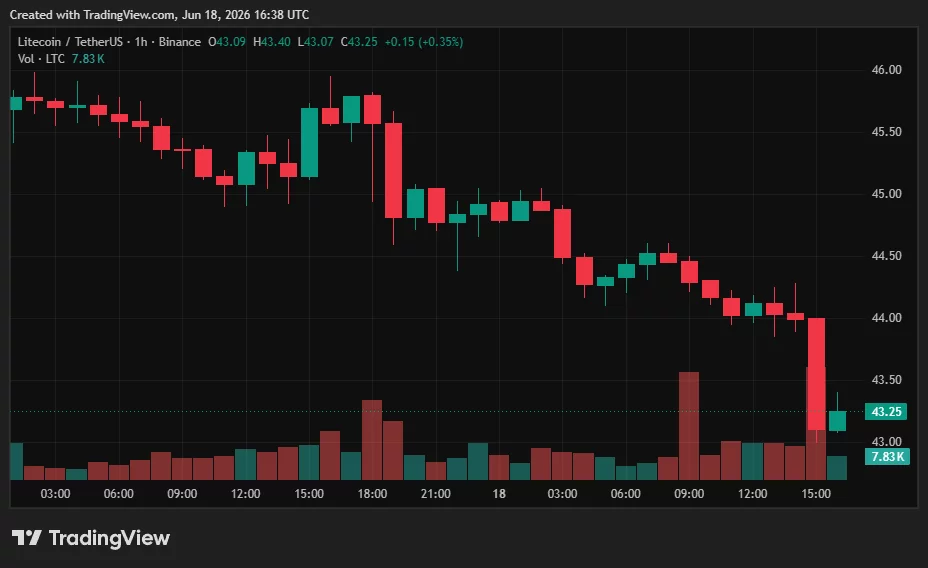
Litecoin (LTC) price fell 5.6% over the past 24 hours and touched an intraday low of $43 on June 17, even as whale accumulation and attention around LitVM continued to grow.